Lei and Kai’s work on ProtRAP-LM has been published in Genom. Proteom. Bioinform. (link). The study introduces ProtRAP-LM, a transformer-based model that uses protein language model embeddings to rapidly and accurately predict membrane contact probability (MCP) and relative accessibility for each residue within a given protein sequence. ProtRAP-LM achieves a speed-up of over 300 times compared to MSA-based MCP predictor, enabling proteome-wide predictions within hours. This facilitates large-scale analysis of challenging membrane protein classes, including single-pass transmembrane proteins, membrane-anchored proteins, and β-sheet-containing membrane proteins. In particular, this study provides a comprehensive list of membrane proteins across 48 proteomes, including 78 potential human membrane proteins, offering a valuable resource for future structural and functional studies. An online server is available at http://www.songlab.cn/ProtRAP-LM/home/. Congratulations!
MemConverter online
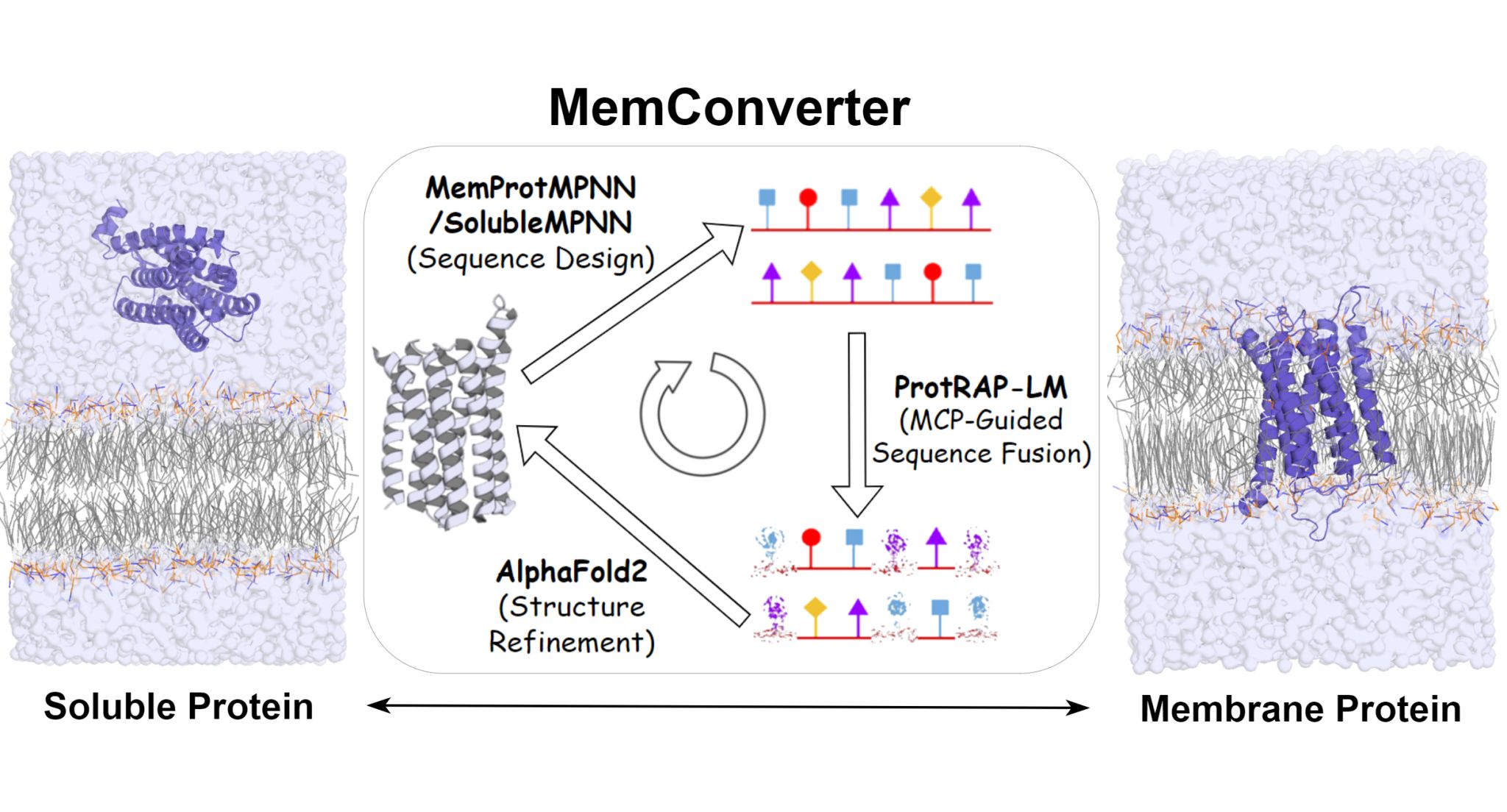
Jun's MemConverter work has been published in J. Chem. Theory Comput. (link). MemConverter is a computational pipeline for converting soluble proteins to membrane proteins — and vice versa. Guided by membrane contact probability (MCP), the method iteratively couples MemProtMPNN or SolubleMPNN with AlphaFold2 prediction, enabling automated and data-driven engineering of proteins to adapt to membrane or aqueous environments. MD simulations was conducted by Haozhe. Congratulations!

Tadsanee Left
Tadsanee has finished her postdoctoral training and moved to Peter J. Bond's lab at A*STAR Bioinformatics Institute. She did excellent work on MD simulations of the Erlin1/2 complex and membrane-lytic antimicrobial peptides. All the best for her new journey!
CQB Annual Meeting 2025
As we welcomed the new year of 2026, our group took part in the CQB Annual Meeting 2025, held on January 10-11, 2026. During the conference, Ruihan presented works on screening and designing membrane-lytic antimicrobial peptides, and Lingfeng introduced the three-ion knock-on mechanism in CaV1 channel, with Ruihan receiving the Quantitative Biology Scholarship. All group members have demonstrated outstanding dedication and achievement throughout the past year—congratulations to each one!
This year also marks the tenth anniversary of Song Group's establishment. We look forward to celebrating this meaningful milestone together. May the group continue to thrive, achieve new heights, and keep up the excellent work in the years to come!
Qingyang left
Qingyang has completed his PhD and will join China National Petroleum Corporation. He conducted outstanding researches on the MD simulations of GPx4 and the development of Brief Sampling method. We wish him every success and fulfillment in his future career.
Pacifichem 2025
Second AMP paper online
Jiaxuan's AMP screening work has been published in Adv. Sci. (Link). This study introduces a mechanism-driven screening approach that leverages machine learning-based computational models to identify antimicrobial peptide sequences capable of targeting bacterial membranes and forming pores. Screening metaproteomes from poison frogs, African clawed frogs, and human skin led to the identification and validation of seven novel peptides. Each exhibited potent antimicrobial activity while demonstrating minimal hemolysis and cytotoxicity. Liposome leakage assays confirmed membrane disruption, with three peptides showing broad-spectrum efficacy against both Gram-positive and Gram-negative bacteria. Single-molecule experiments visualized peptide oligomerization on membranes, and electrophysiological measurements directly verified pore formation by the three broad-spectrum AMPs, suggesting a strong correlation between pore-forming capability and broad-spectrum activity. This research establishes a promising, mechanism-driven strategy for discovering new antimicrobial agents to combat antibiotic resistance. We extend our congratulations to Jiaxuan and all collaborators on this significant publication. Congratulations!
iHuman Forum 2025
Prof. Chen SONG was invited to deliver a presentation at the 10th iHuman Forum, convened at ShanghaiTech University from October 31 to November 1, 2025. His talk, entitled "Decoding the Molecular Mechanisms of Valence Selectivity in Ca²⁺ Channels: A Computational Study," addressed key computational insights into ion channel selectivity.
(This photo was taken by Prof. Yuji Sugita)
SMART Symposium 2025
From October 24th to 26th, 2025, our group participated in the SMART Symposium: 2025 Frontier Symposium in Computational Chemistry, Biophysics, and Biological Sciences held in Shenzhen, China. Prof. Chen SONG and Ruihan were invited to deliver presentations showcasing our group's recent research advancements. We are pleased to announce that Tadsanee received the Poster Award. Congratulations!!
Ruihan wins National Scholarship
A huge congratulations to Ruihan on winning the National Scholarship! Congratulations!!